股票期权性质

Properties of Stock Options
学习目标 (Learning Objectives)
- 理解期权基础与期权市场运行机制:
- 四种基本期权头寸:看涨多头、看涨空头、看跌多头、看跌空头
- 美式期权与欧式期权的核心差异
- 内在价值 (Intrinsic Value) 与时间价值 (Time Value)
- 期权值度 (Moneyness):实值、平值与虚值
- 期权做市商机制 (Market Making)
- 现金红利派发与股票拆分对期权条款的调整
- 探讨影响期权价格的关键决定因素
- 计算欧式与美式看涨、看跌期权价格的上下限:
- 深入理解红利现值对期权价格上下界的影响
- 演示当市场价格突破理论边界时的无风险套利策略
- 掌握买卖权平价定理 (Put-Call Parity) 并利用平价偏离构建套利交易
- 分析美式看涨期权与看跌期权的提前行权 (Early Exercise) 边界条件
Learning Objectives
- Understand options and options markets:
- The four basic options positions: long call, short call, long put, short put
- American and European options
- Intrinsic value and time value
- Moneyness
- Market making
- The effect of dividends and stock splits
- Discuss the factors affecting option prices
- Calculate upper and lower bounds of call and put prices:
- Understand the effect of dividends on the bounds
- Illustrate arbitrage opportunities when prices fall outside bounds
- Understand put-call parity and construct arbitrage strategies from its violation
- Understand the early exercise feature of American put and call options
前置知识储备 (Assumed Knowledge)
- 期权合约的基本结构要素
- 澳大利亚证券交易所 (ASX) 期权市场交易机制
- 看涨与看跌期权的损益特征与实际应用:
- 非对称内在价值收益曲线
- 到期行权决策分析
- 看涨期权用于投资杠杆与风险对冲
- 看涨期权空头(立权人)的义务与风险
- 期权价格构成原理:
- 时间价值及其经济来源
- 行权 (Exercise) 与平仓对冲 (Closeout) 的决策对比
Assumed Knowledge
- Basic features of option contracts
- ASX options market
- The characteristics and uses of calls and puts:
- Asymmetric intrinsic value
- The exercise decision
- Calls as investments and hedges
- The short call position
- Option prices:
- Time value and its sources
- Exercise versus closeout
期权基础定义与分类 (Options)
- 期权类别 (Option class):
- 看涨期权 (Call):买入基础资产的权利
- 看跌期权 (Put):卖出基础资产的权利
- 期权行权类型 (Option types):
- 欧式期权 (European options):仅能在到期日当天行权
- 美式期权 (American options):可在到期日或到期日之前的任何交易日行权
- 期权头寸 (Option positions):
- 多头 (Long):买方支付期权费,享有以有限下行风险博取杠杆收益的权利。
- 买入期权并支付期权费(价格)• 享有权利,无履约义务
- 空头 (Short):卖方(立权人)收取期权费,但承担在买方行权时必须按约定履约的义务。
- 卖出(签发)期权并收取期权费(价格)• 承担履约义务,无主动选择权
- 多头 (Long):买方支付期权费,享有以有限下行风险博取杠杆收益的权利。
Options
- Option class:
- Call: Option to buy an underlying asset
- Put: Option to sell an underlying asset
- Option types:
- European options: Can only be exercised at maturity
- American options: Can be exercised at any time before or at maturity
- Option positions:
- Long: The buyer has the opportunity to earn a leveraged profit with limited risk, for which they pay a premium.
- Buys option and pays premium (price) • Has a right
- Short: The writer has the opportunity to earn premium income, but has the obligation to meet the claim of the buyer when exercised.
- Sells (writes) option and receives premium (price) • Has an obligation
- Long: The buyer has the opportunity to earn a leveraged profit with limited risk, for which they pay a premium.
符号表示法 (Notation)
| 数学符号 | 专业定义与经济含义 |
|---|---|
| 欧式看涨期权价格 (European call option price) | |
| 美式看涨期权价格 (American call option price) | |
| 欧式看跌期权价格 (European put option price) | |
| 美式看跌期权价格 (American put option price) | |
| 期权到期期限(以年为单位) | |
| 当前股票价格 (Current stock price) | |
| 期权到期日的股票价格 (Stock price at maturity) | |
| 执行价格 / 履约价格 (Strike price / Exercise price) | |
| 股票价格的年化波动率 (Volatility) | |
| 期权有效期内预期派发红利的贴现现值 | |
| 对应期限 |
Notation
| Symbol | Definition |
|---|---|
| European call option price | |
| American call option price | |
| European put option price | |
| American put option price | |
| Option maturity (in years) | |
| Stock price today | |
| Stock price at option maturity | |
| Strike price / Exercise price | |
| Volatility of stock price | |
| Present value of dividends during option's life | |
| Continuously compounded risk-free rate for maturity |
四种基本期权头寸到期回报
- 看涨期权多头 (Long call):买方有权按执行价
- 看涨期权空头 (Short call):卖方承担按执行价
- 看跌期权多头 (Long put):买方有权按执行价
- 看跌期权空头 (Short put):卖方承担按执行价
| 到期股票价格 | 看涨期权多头 | 看涨期权空头 | 看跌期权多头 | 看跌期权空头 |
|---|---|---|---|---|
Options Positions
- Long call: Buyer has right to buy underlying at strike
- Short call: Writer has obligation to sell underlying at strike
- Long put: Buyer has right to sell underlying at strike
- Short put: Writer has obligation to buy underlying at strike
| Terminal Price | Long Call | Short Call | Long Put | Short Put |
|---|---|---|---|---|
期权到期回报与净盈亏 (Payoffs & Profit/Loss)
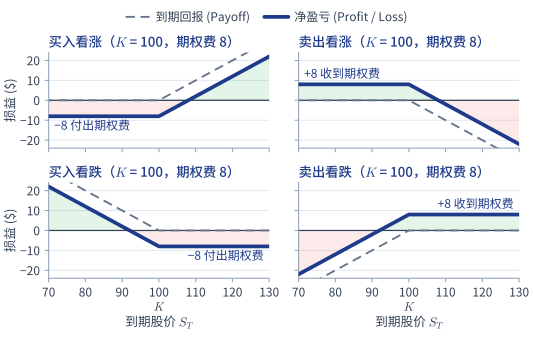
- 到期回报 (Payoff):期权在到期日因行权(或放弃行权)所产生的现金结算流入或流出金额。
- 净盈亏 / 净利润 (Profit / Loss):期初支付或收取的期权费与到期回报的代数加总:
Options Payoffs and Profit/Loss
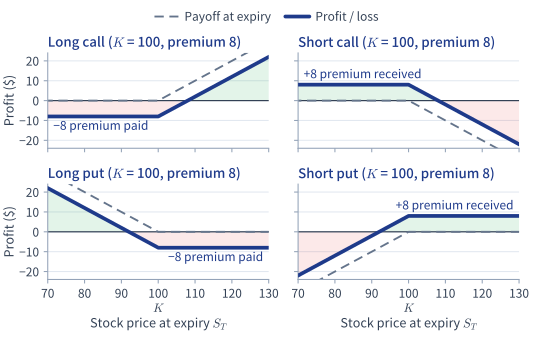
- Payoff: The amount received / paid at maturity when the option is exercised.
- Profit / Loss: The combined amount calculated as the sum of the option's premium paid / received at initiation and the option's payoff at maturity.
核心术语:内在价值与时间价值
- 内在价值 (Intrinsic value):假定期权立即按基础资产当前价格行权所能获得的理论收益:
- 看涨期权内在价值:
- 看跌期权内在价值:
- 看涨期权内在价值:
- 时间价值 (Time value):期权当前市场价格超出其内在价值的溢价差额:
- 为什么投资者愿意支付高于内在价值的溢价?因为期权赋予了持有者在未来股价发生有利变动时赚取巨额收益的可能,同时严格锁定了最大潜在下行亏损。
- 计算案例:股价 $100,执行价 $90 的看涨期权:内在价值
图:蓝线是内在价值,红线是期权价格,两线在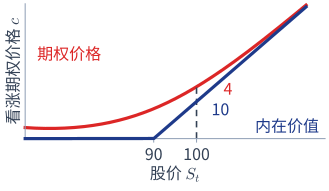
Key Terminology: Intrinsic Value & Time Value
- Intrinsic value: The theoretical payoff if the option were exercised immediately at the current price of the underlying asset:
- Call intrinsic value:
- Put intrinsic value:
- Call intrinsic value:
- Time value: The excess of the option's current market price over its intrinsic value:
- Why are investors willing to pay more than intrinsic value? Because the option gives the holder the possibility of large gains from favourable future stock price movements, while strictly capping the maximum potential downside loss.
- Example: A call option on a $100 stock with strike $90 has intrinsic value
Chart: the blue line is the intrinsic value, the red line the option price; the gap between them at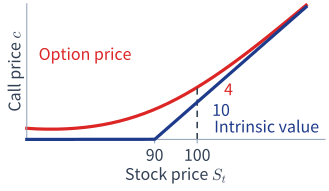
核心术语:期权值度 (Moneyness)
- 平值期权 / 平价期权 (At-the-money, ATM):
- 股票当前市场价格严格等于期权执行价格:
- 此时内在价值严格为零:
- 股票当前市场价格严格等于期权执行价格:
- 实值期权 / 价内期权 (In-the-money, ITM):
- 拥有严格大于零的内在价值的期权:
- 看涨期权实值条件:
- 看跌期权实值条件:
- 虚值期权 / 价外期权 (Out-of-the-money, OTM):
- 内在价值为零且在当前价格下绝不会立即行权的期权:
- 看涨期权虚值条件:
- 看跌期权虚值条件:
Terminology: Moneyness
- At-the-money (ATM):
- An option where the current stock price equals strike:
- Its intrinsic value is zero:
- An option where the current stock price equals strike:
- In-the-money (ITM):
- An option with positive intrinsic value:
- Out-of-the-money (OTM):
- An option with zero intrinsic value that would not be exercised today:
期权价值分解与非线性时间价值衰减
期权的总市场价格由内在价值(立即行权价值)与时间价值(对未来波动的投机性溢价)两部分构成。时间价值衰减 (
| 执行价格 ( |
期权值度 ( |
期权总价格 | 内在价值 | 时间价值 | 到期演化行为 |
|---|---|---|---|---|---|
| $90 看涨期权 | 实值 (ITM) | $14 | $4 | 保留 |
|
| $100 看涨期权 | 平值 (ATM) | $8 | $8 (100%) | 拥有最高的时间价值与 Gamma(价值曲线的曲率);对波动率变化最敏感 | |
| $110 看涨期权 | 虚值 (OTM) | $4 | $4 (100%) | 若 |
- 虚值期权到期归宿:所有虚值期权内在价值均为零。若到期时未能进入实值区间,全部期权费将归零蒸发。
Decomposing Option Value & Non-Linear Time Decay
An option's total price consists of intrinsic value (immediate exercise value) and time value (a speculative premium on future volatility). Time decay (
| Strike ( |
Moneyness ( |
Total Premium | Intrinsic Value | Time Value | Behavior at Expiration |
|---|---|---|---|---|---|
| $90 Call | In-the-Money (ITM) | $14 | $4 | Retains |
|
| $100 Call | At-the-Money (ATM) | $8 | $8 (100%) | Highest time value and gamma (curvature of the value curve); most sensitive to volatility | |
| $110 Call | Out-of-the-Money (OTM) | $4 | $4 (100%) | If |
- OTM options at expiration: All out-of-the-money options have zero intrinsic value; if not in-the-money at expiration, the entire premium evaporates to zero.
红利与股票拆分对期权条款的调整
- 公司行为导致的期权条款调整规则:
- 考虑某股票的期权,每份合约涵盖
- 现金红利 (Cash dividends):交易所交易期权对上市公司发放的普通现金红利不作任何条款调整。
- 股票拆分 (Stock splits):当公司执行
- 执行价格相应下调为
- 每份合约涵盖的股票数量调整为
- 执行价格相应下调为
- 送红股(股票股利):与股票拆分遵循完全相同的调整比例处理。
- 考虑某股票的期权,每份合约涵盖
- 典型案例演示:假设某看涨期权涵盖以每股 $100 买入 100 股股票。
- 2-拆-1 股票拆分:该合约调整为有权按每股
- 25% 送红股(股票股利):等价于 5-拆-4 拆分。执行价调整为
- 2-拆-1 股票拆分:该合约调整为有权按每股
Dividends and Stock Splits
- Rules for adjusting option terms after corporate actions:
- Consider options on a stock, where each contract covers
- Cash dividends: Exchange-traded options are not adjusted at all for ordinary cash dividends paid by the listed company.
- Stock splits: When the company carries out an
- The strike price is reduced to
- The number of shares covered by each contract is adjusted to
- The strike price is reduced to
- Stock dividends: Handled with exactly the same adjustment ratio as stock splits.
- Consider options on a stock, where each contract covers
- Example: Suppose a call option covers the right to buy 100 shares at $100 per share.
- 2-for-1 stock split: The contract is adjusted to the right to buy 200 shares at
- 25% stock dividend: Equivalent to a 5-for-4 split. The strike is adjusted to
- 2-for-1 stock split: The contract is adjusted to the right to buy 200 shares at
交易所交易期权机制 (ETOs)
- 交易所交易期权的基础资产类别:
- 个股股票 • 外汇汇率 (Hull 第15章) • 股票价格指数 (Hull 第15章) • 期货合约 (Hull 第16章)
- 保证金制度 (Margins):当投资者卖出(签发/立权)交易所期权时必须缴纳保证金:
- 保证金资产形式可包括非现金资产,如合资格股票、银行保函等。
- 资金流向:投资者 → 期货/证券经纪商 → 期权清算所 (OCH)。
- 仅有现金形式的保证金方可计付利息。
- 期权买方无保证金:买入看涨或看跌期权时,必须在期初全额预付期权费。严禁利用保证金借贷杠杆购买期权。
- 做市商制度 (Market Makers):绝大多数交易所依托专业做市商持续提供双向流动性支持。
- 双向报价 (The Double):做市商在收到询价请求时,必须同时报出具有约束力的买价 (Bid) 与卖价 (Ask)。
Exchange Traded Options (ETOs)
- Assets Underlying ETOs:
- Stocks • Foreign currency (Hull Ch 15) • Stock Indices (Hull Ch 15) • Futures (Hull Ch 16)
- Margins: Required when exchange-traded options are sold (written):
- Margin payments can be non-cash assets such as shares, bank guarantees, etc.
- Flow: Investor → Broker → OCH (Option Clearing House)
- Only cash margin earns interest.
- Option Buyers: When call or put options are bought, the option premium must be paid in full upfront. You are not allowed to buy options on margin.
- Market Makers: Most exchanges rely on market makers to facilitate options trading, which adds vital liquidity.
- The Double: A market maker quotes both bid and ask prices when requested (quoting the "double").
影响期权价格的决定因素汇总 (Hull 表 10.1)
| 市场输入变量 | 欧式看涨 ( |
欧式看跌 ( |
美式看涨 ( |
美式看跌 ( |
|---|---|---|---|---|
| 当前股票价格 ( |
+ | − | + | − |
| 执行价格 ( |
− | + | − | + |
| 距到期时间 ( |
? | ? | + | + |
| 股价波动率 ( |
+ | + | + | + |
| 无风险利率 ( |
+ | − | + | − |
| 预期派发红利现值 ( |
− | + | − | + |
How the Parameters Affect Option Prices
| Variable | European Call ( |
European Put ( |
American Call ( |
American Put ( |
|---|---|---|---|---|
| Current stock price ( |
+ | − | + | − |
| Strike price ( |
− | + | − | + |
| Time to expiration ( |
? | ? | + | + |
| Volatility ( |
+ | + | + | + |
| Risk-free interest rate ( |
+ | − | + | − |
| Amount of future dividends ( |
− | + | − | + |
价格影响因素的经济学机制剖析
- 现货价格与执行价格:
- 看涨期权内在价值:
- 看跌期权内在价值:
- 看涨期权内在价值:
- 期限时间:
- 欧式期权:仅能在到期日行权一次。若延长期限内有大额红利派发,可能压低到期股票价格,导致其欧式看涨价格下降(故方向不确定 "?")。
- 美式期权:拥有随时行权的完全自主权 → 期限越长,选择权越多,价值必定越高。
- 波动率:
- 期权具有“下行亏损有限、上行收益无限”的凸性收益特征:持有者享受有利波动的利润,不利波动时直接放弃行权。
- 波动率越高,基础资产出现大幅极端有利波动的概率越大,同时推高看涨与看跌期权价值。对期货不重要。
- 无风险利率:
- 利率上升提高基础资产的预期增长漂移率,同时降低执行价
- 根据 CAPM,
- 利率上升提高基础资产的预期增长漂移率,同时降低执行价
- 预期红利:除息日股价会因红利剥离而下跌对应金额,因此红利增加降低看涨价格、推高看跌价格。
How Parameters Affect Option Prices
- Spot and Strike:
- Call intrinsic value:
- Put intrinsic value:
- Call intrinsic value:
- Time:
- European: only one opportunity to exercise at maturity.
- American: More flexibility on when to exercise → longer life always adds value.
- Dividend expected during the extended period? May reduce European call value.
- Volatility:
- Options eliminate downside risk: owner benefits from upside, walks away on downside.
- Higher volatility increases the probability of large favorable outcomes, raising both calls and puts. Not important for futures.
- Interest rates:
- Higher risk-free rate increases expected stock drift and reduces the PV of strike
- CAPM: spot price rises with
- Higher risk-free rate increases expected stock drift and reduces the PV of strike
- Dividends:
- Stock price drops on ex-dividend date by the dividend amount.
- As dividend
欧式期权价格理论上下限
无红利资产 (No Dividends)
看涨期权价格边界:
- 下限:
- 上限:
看跌期权价格边界:
- 下限:
- 上限:
支付已知红利资产 (
看涨期权价格边界:
- 下限:
- 上限:
看跌期权价格边界:
- 下限:
- 上限:
Bounds for European Option Prices
No Dividends
Call Bounds:
- Lower Bound:
- Upper Bound:
Put Bounds:
- Lower Bound:
- Upper Bound:
With Dividends (
Call Bounds:
- Lower Bound:
- Upper Bound:
Put Bounds:
- Lower Bound:
- Upper Bound:
简单例子 – 发现下限套利机会
- 第一步,算下限:利率为 0 时
- 为什么至少值 $10?“1 份看涨期权 + $90 现金”到期一定能换到 1 股股票(股价高就行权,股价低就直接买),所以它不会比 1 股股票便宜:
- 一般形式:若有红利,设红利金额为
- 第二步,比较:市价 $8 < 下限 $10 → 期权便宜了 $2,存在无风险套利(上限
Simple Example – Spotting a Lower-Bound Arbitrage
- Step 1 — lower bound: with a zero rate
- Why at least $10? 1 call + $90 cash always becomes 1 share at maturity (exercise if the price is high, buy the share if it is low), so it cannot be worth less than 1 share:
- General form: with dividend amount
- Step 2 — compare: price $8 < bound $10 → underpriced by $2: riskless arbitrage (the upper bound
简单例子 – 下限套利怎么做
- 今天:卖空 1 股股票,收到 +$100;买入 1 份看涨期权,付出 −$8 → 手里剩 $92,自己不用出一分钱。
- 到期:用这 $92 买回 1 股股票,还给借股票的人。
- 有红利、利率 > 0 时:要先把红利现值存 1 个月,到时付出红利;其余本金存到期末,按
| 到期股价 | 怎么买回股票 | 花费 | 剩下(利润) |
|---|---|---|---|
| $120(涨) | 行权,按 $90 买 | $90 | |
| $70(跌) | 放弃期权,市场上按 $70 买 | $70 |
Simple Example – Executing the Lower-Bound Arbitrage
- Today: short 1 share (+$100), buy 1 call (−$8) → $92 in hand — self-financing.
- At maturity: use the $92 to buy back 1 share and return it.
- With a dividend and
| Price at maturity | How you buy back the share | Cost | Profit |
|---|---|---|---|
| $120 (up) | Exercise the call, buy at $90 | $90 | |
| $70 (down) | Call lapses; buy at $70 in the market | $70 |
再加一点:有红利时的下限套利
市价只有 $3 → 便宜了 $2
| 时间 | 操作 | 现金流 | 手里现金 |
|---|---|---|---|
| 今天 | 卖空 1 股股票 买入 1 份看涨期权 | +$100 −$3 | $97 |
| 派息日 | 替借你股票的人付 $5 红利(卖空者要补) | −$5 | $92 |
| 到期 | 买回 1 股还回去:股价 ≥ $90 就行权按 $90 买,股价 < $90 就在市场上买 | 最多 −$90 | 至少 $2 |
One Step Further: Lower-Bound Arbitrage with a Dividend
Market price only $3 → underpriced by $2
| Time | Action | Cash flow | Cash in hand |
|---|---|---|---|
| Today | Short sell 1 share Buy 1 call option | +$100 −$3 | $97 |
| Dividend date | Cover the $5 dividend for the share lender | −$5 | $92 |
| Maturity | Buy back 1 share: exercise at $90 if price | at most −$90 | at least $2 |
买卖权平价定理 (Put-Call Parity)
- 构建以下两个基准投资组合:
- 组合 A (Portfolio A):1 份欧式看涨期权 + 面值为执行价
- 组合 B (Portfolio B):1 份欧式看跌期权 + 1 股股票:
- 组合 A (Portfolio A):1 份欧式看涨期权 + 面值为执行价
- 到期日 (
- 组合 A 到期价值:
- 组合 B 到期价值:
- 组合 A 到期价值:
- 无套利平价等式:由于两个组合在到期日所有可能的状态下收益完全相同,根据一价定律,它们今日的市场价值必须严格相等:
- 支付已知红利资产的修正形式(其中
Put-Call Parity
- Consider the following two portfolios:
- Portfolio A: One European call option on a stock plus the PV of the strike price in cash:
- Portfolio B: One European put option on the stock plus one share of stock:
- Portfolio A: One European call option on a stock plus the PV of the strike price in cash:
- Payoff at maturity (
- Portfolio A:
- Portfolio B:
- Portfolio A:
- No-Arbitrage Relationship: Both portfolios yield identical payoffs under all possible states of the world at maturity. Therefore, they must have the same market value today:
- For a dividend-paying stock (with
简单例子 – 发现平价套利机会
- 第一步,写出平价等式:利率为 0 时
- 一般形式:有红利且
- 第二步,两边各算一遍:
- 左端(看涨期权 + 现金):
- 右端(看跌期权 + 股票):
- 左端(看涨期权 + 现金):
- 第三步,比较:两个组合到期回报完全相同(都是
Simple Example – Spotting a Put-Call Parity Arbitrage
- Step 1 — parity equation: a zero rate gives
- General form:
- Step 2 — evaluate both sides:
- Left side (call + cash):
- Right side (put + stock):
- Left side (call + cash):
- Step 3 — compare: both pay
简单例子 – 平价套利怎么做
- 今天:卖空 1 股股票,收到 +$100;卖出 1 份看跌期权,收到 +$8;买入 1 份看涨期权,付出 −$5;把 $100 存入银行(利率为 0,到期取回还是 $100)→ 手里剩 $3,自己不用出一分钱。
- 有红利、
- 到期:从银行取回 $100,无论如何都按 $100 买回 1 股股票,还给借股票的人。
| 到期股价 | 哪份期权派上用场 | 买回股票的花费 | 利润 |
|---|---|---|---|
| $120(涨) | 看跌期权作废;行权看涨期权,按 $100 买 | $100(用取回的存款付) | 今天留下的 $3 |
| $80(跌) | 看涨期权作废;对手方行权看跌期权,按 $100 买 | $100(用取回的存款付) | 今天留下的 $3 |
Simple Example – Executing the Parity Arbitrage
- Today: short 1 share (+$100), write 1 put (+$8), buy 1 call (−$5), deposit $100 at the bank (rate 0: $100 back at maturity) → $3 in hand — self-financing.
- At maturity: withdraw the $100, buy back 1 share for exactly $100, and return it.
| Price at maturity | Which option is used | Buy-back cost | Profit |
|---|---|---|---|
| $120 (up) | Put expires worthless; exercise the call, buy at $100 | $100 (from the deposit) | The $3 kept today |
| $80 (down) | Call expires worthless; the put is exercised against us, buy at $100 | $100 (from the deposit) | The $3 kept today |
复制合成头寸与套利现金流表
- 合成看涨:
- 合成看跌:
- 合成现货股票:
- 合成无风险债券:
左端
左端高于右端达 $5 → 卖出高估的左端(卖看涨、借入资金),买入低估的右端(买看跌、买现货股票)。
| 时间节点 | 对冲交易组合操作 | 现金流收支 ($) | 机制运作与到期结果 |
|---|---|---|---|
| 今日 ( |
卖出 1 份欧式看涨期权 买入 1 份欧式看跌期权 买入 1 股股票 向银行借款补足差额 |
净投入: $0 |
收取高估看涨期权费。 支付看跌期权保护费。 买入被低估的现货股票。 精确借入差额 零初始资金投入! |
| 派息日 | 收取股票红利 用红利偿还一部分借款 |
净现金流: $0 |
收到持有股票所享有的 $5 分红。 利率为 0,直接拿去还借款:欠款从 $100 降为 $95。 |
| 第 1 年末 ( |
股票按 偿还银行借款余额 |
净利润: +$5 |
无论 偿还借款余额 $95(利率为 0,无利息)。 锁定净利润 |
Synthetic Positions & Arbitrage Cash Flow Table
- Synthetic call:
- Synthetic put:
- Synthetic stock:
- Synthetic risk-free bond:
Left side
Left side > right side by $5 → sell the overvalued left side (sell call, borrow), buy the undervalued right side (buy put, buy stock).
| Timing | Hedge portfolio trades | Cash flows ($) | Mechanics & outcome |
|---|---|---|---|
| Today ( |
Sell 1 European call Buy 1 European put Buy 1 share of stock Borrow the shortfall |
Net: $0 |
Collect the overvalued call premium. Pay for the put protection. Buy the undervalued stock. Borrow exactly Zero initial investment! |
| Dividend date | Receive the stock dividend Use it to repay part of the loan |
Net: $0 |
Receive the $5 dividend on the stock. At zero interest it repays the loan: balance falls $100 → $95. |
| End of year 1 ( |
Sell the stock at Repay the remaining bank loan |
Net profit: +$5 |
Call exercised against us if Repay the $95 loan (zero rate, no interest). Net profit |
美式期权核心性质 (American Options)
- 与欧式期权的价值关系:美式期权价值必定不低于对应的欧式期权,因为美式期权包含了欧式期权的全部行权权利外加提前行权的灵活性:
- 提前行权概率:通常情况下,美式期权存在正的提前行权概率溢价。
- 最关键的例外定理:对于不支付红利的股票,美式看涨期权提前行权永远不是最优选择。因此:
- 资金时间价值:推迟行权可将支付执行价所需的资金
- 无红利损失:由于股票不分红,推迟行权不会遭受任何股利流失。
- 下行保险保护:持有看涨期权提供了防范股价跌破执行价的保险功能。提前行权过早将受保护的期权转化为了承担完全下跌风险的现货股票。
- 资金时间价值:推迟行权可将支付执行价所需的资金
American Options
- Value relation to European options: An American option is worth at least as much as the corresponding European option because it includes all European exercise rights plus early exercise:
- Early exercise probability: Usually there is some positive probability that an American option will be exercised early.
- The Major Exception: An American call on a non-dividend paying stock is never optimal to exercise early. Therefore:
- Time value of money: Delaying exercise keeps the strike price
- No dividend sacrifice: No income is foregone, as the stock pays no dividend.
- Downside protection: Holding the call option provides insurance against the stock price falling below the strike. Exercising early converts an insured option into risky stock.
- Time value of money: Delaying exercise keeps the strike price
案例 – 美式看涨期权不可提前行权分析
- 情景设定:考虑某不分红股票的美式看涨期权,参数如下:
此时是否应当立即行使该看涨期权?
- 决策严谨分析:
- 若希望持有股票:应坚持推迟行权至到期日
- 若不希望持有股票:绝不可提前行权!应直接在市场上卖出期权平仓。
- 若希望持有股票:应坚持推迟行权至到期日
- 严谨数学证明:
- 立即行权所能兑现的仅为内在价值
- 而在市场上,
- 提前行权无端白白丢弃了期权剩余的全部时间价值!
- 立即行权所能兑现的仅为内在价值
Example – Why an American Call Should Not Be Exercised Early
- Scenario: an American call on a non-dividend-paying stock:
Should the call be exercised immediately?
- Decision analysis:
- If you want the stock: delay exercise to maturity
- If you don't want the stock: never exercise early — sell the option.
- If you want the stock: delay exercise to maturity
- Rigorous mathematical proof:
- Exercising now yields only intrinsic value
- With
- Early exercise throws away all the remaining time value!
- Exercising now yields only intrinsic value
美式看跌期权是否应当提前行权?
- 资金时间价值驱动提前行权:行使看跌期权可立即收回执行价现金
- 利息收益与下行保险价值的权衡:
- 持有看跌期权保留了防范股票进一步下跌的保险保护。
- 但若看跌期权处于深度实值 (Deep In-The-Money)(股价已逼近零),股票进一步下跌的空间极其有限,保险价值近乎为零!
- 此时立即收回现金
- 量化分析案例:考虑美式看跌期权参数:
- 是否应立即行使该看跌期权?应当立即行权!
- 立即行权可获得现金:
- 将 $98 存入银行 1 年按 5% 计息,稳拿利息收益
- 等待的最大额外收益是多少?即便股价彻底归零(
Should American Puts Be Exercised Early?
- The time value of money drives early exercise: exercising the put recovers the strike
- Weighing interest income against downside insurance:
- Holding the put keeps insurance against further falls in the stock price.
- But if the put is deep in-the-money (price near zero), little room to fall remains — insurance value nearly zero!
- Receiving
- Quantitative example: Consider an American put with parameters:
- Should the put be exercised immediately? Yes — exercise now!
- Immediate exercise yields cash:
- Deposit the $98 for 1 year at 5%: guaranteed interest of
- Maximum profit from waiting? Even if the stock falls to zero (
美式期权价格理论上下限
无红利资产 (No Dividends)
美式看涨价格边界:
- 下限:
- 上限:
美式看跌价格边界:
- 下限:
- 上限:
支付红利资产 (
美式看涨价格边界:
- 下限:
- 上限:
美式看跌价格边界:
- 下限:
- 上限:
Bounds for American Option Prices
No Dividends
Call Bounds:
- Lower Bound:
- Upper Bound:
Put Bounds:
- Lower Bound:
- Upper Bound:
With Dividends (
Call Bounds:
- Lower Bound:
- Upper Bound:
Put Bounds:
- Lower Bound:
- Upper Bound:
美式期权买卖权平价不等式
- 美式期权买卖权平价不等式约束:由于美式期权具备随时提前行权的权利,严格的等式关系不再成立,转变为严格的上下界区间不等式:
公式 (10.7),Hull 英文原书第 259 页
- 支付红利资产的平价不等式 (
- 现实市场中买卖权平价关系偏离严格等式的原因:
- 市场摩擦与交易成本:买卖买卖价差与经纪手续费构筑了一定宽度的无套利缓冲区间。
- 提前行权权利溢价:交易所期权(如 ASX 挂牌期权)多为美式,提前行权价值使得等式转化为不等式边界。
Put-Call Parity for American Option Prices
- American Put-Call Parity Inequalities: Because American options can be exercised early, exact equality does not hold. Instead, option prices satisfy strict bounds:
Equation (10.7), Hull Page 259
- With Dividends (
- Why does Put-Call Parity not always hold as an exact equality?
- Transaction costs: Bid-ask spreads and brokerage fees create a no-arbitrage band.
- Early exercise rights: Exchange traded options (such as on the ASX) are usually American-style, introducing early exercise premiums.
提前行权边界:美式看跌期权 vs 看涨期权
看涨与看跌期权的核心非对称性
提前行权本质上是现金利息收入与下行保险保护价值之间的微观经济权衡。
美式看涨期权(无红利)
- 提前行权绝非最优:
- 行权需要提前支付现金
- 股价理论上具有无限上涨空间;持有期权保留了免受跌破
- 支付红利情形:仅在除息日前夕,且预期红利现值超过推迟行权节省的利息损失
美式看跌期权(深度实值)
- 提前行权频繁为最优:
- 行权可立即收取执行价现金
- 股价下行有严格底线(最低为 $0)。当
- 临界行权边界
The Early Exercise Boundary: American Puts vs Calls
Core Asymmetry Between Calls and Puts
Early exercise is fundamentally an economic trade-off between interest earned on cash and the value of downside insurance.
American Calls (No Dividends)
- Never optimal to exercise early:
- Exercising requires paying cash
- Stock price has unlimited upside; holding the call preserves insurance against a decline below
- With dividends: Early exercise can only be optimal immediately prior to an ex-dividend date if the dividend exceeds foregone interest:
American Puts (Deep In-The-Money)
- Frequently optimal to exercise early:
- Exercising receives cash
- Stock price cannot fall below $0 (bounded below). As
- Critical Boundary